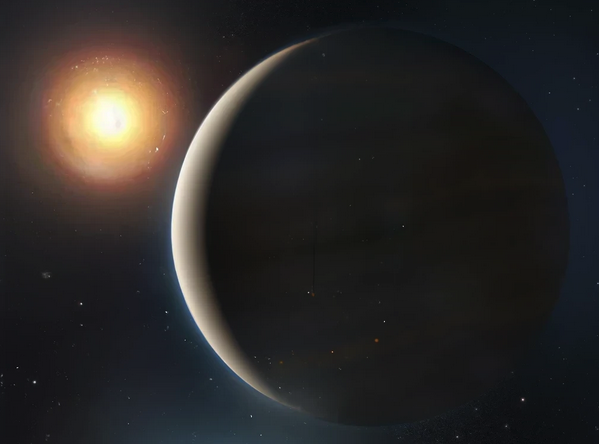
“There are infinite worlds both like and unlike this world of ours.” Epicurus
Background
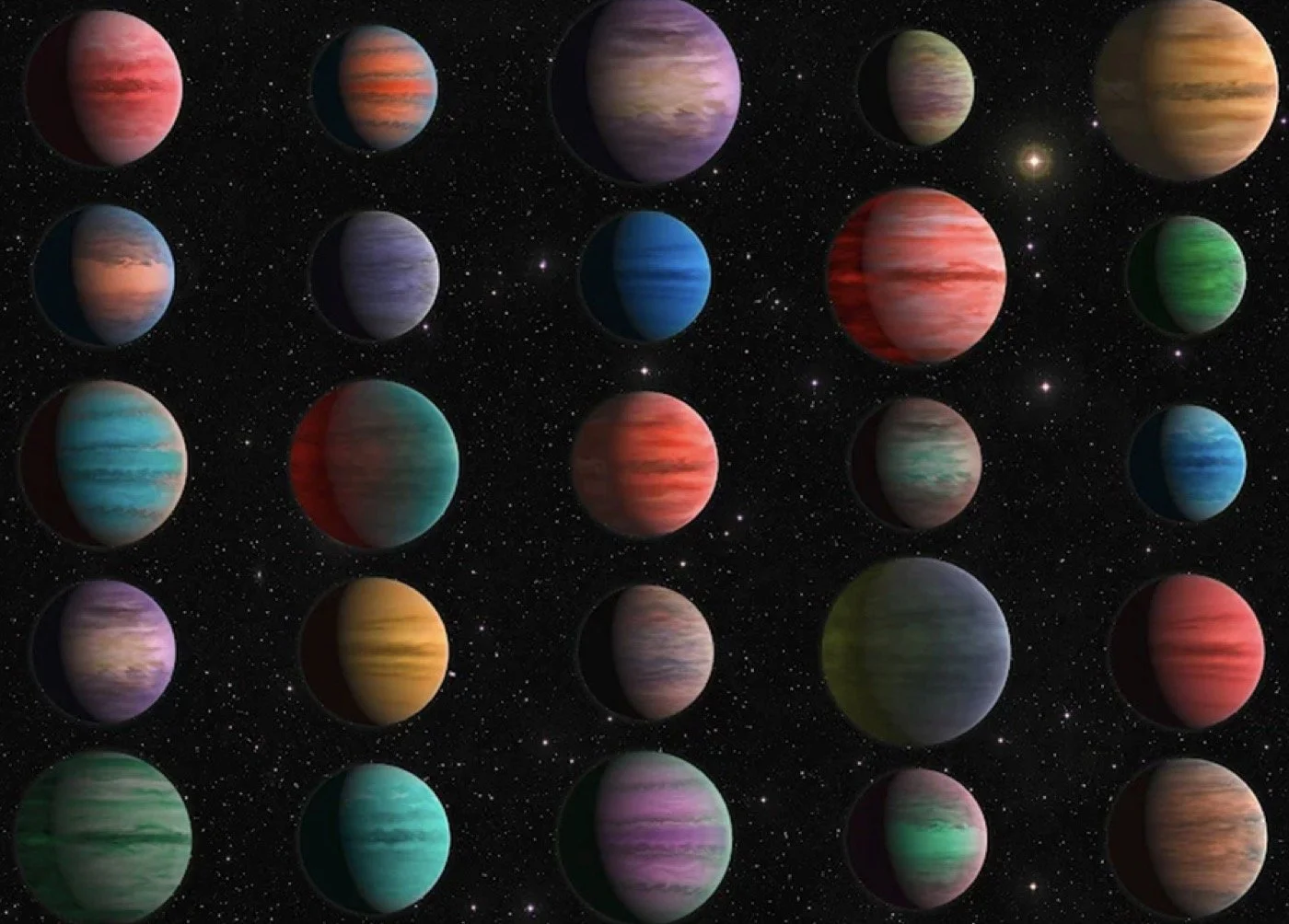
My research has mainly focused on studying planets around other stars (e.g., exoplanets). The study of exoplanets is ultimately derived from humanity’s need to understand our place in the universe. Questions like “Are we alone?” or “How did we get here?” have been asked for thousands of years and only answered through philosophy or science fiction. The first exoplanet was discovered in 1992 and today there are over 6000 known planets. We now know that every star in the night sky has at least one planet orbiting around it! Astronomers have not only been able to discover them (a great feat in itself), we can characterize their fundamental proprieties (mass, radius), orbits, temperatures, and atmospheres. The golden age of exoplanet science now coincides with a renaissance in SETI (the search for extraterrestrial intelligence) research too. The search for exoplanetary magnetic fields has been going on for decades and hints of conclusive detections are starting to emerge. We are now for the first time in human history starting to answer these age old questions and formulating new ones along the way.
Image Credit: ESA
Discovering New Exoplanets
New exoplanets are being discovered every day. These discoveries are announced weekly at NASA’s Exoplanet Archive. Follow along! Astronomers have developed a suite of indirect methods to detect exoplanets via the way they influence their host stars. Two of the main detection techniques have been the radial velocity and transit method. Other detection techniques include astrometry and gravitational microlensing.
The radial velocity method for spotting exoplanets. | ESO
Finding exoplanets using microlensing. | LCO
The transit method for discovering exoplanets. | NASA Goddard
Finding exoplanets using astrometry. | Cosmos Channel
Exoplanet Transits & Eclipses
The orbits of some exoplanets are aligned such that they pass in front of their host stars. This is referred to as an exoplanet transit and results in the host star becoming dimmer temporarily.
With transits, we can measure an exoplanet’s radius, orbital period (seeing the dips, orbital distance, and its transit time (when the planet is in the middle of its star).
Most exoplanets have constant orbital periods. However, some exoplanets have varying orbital periods, leading to the timing of their transits to occur at irregular intervals. These transit timing variations (TTVs) can be caused by unknown planets or a decaying orbit.
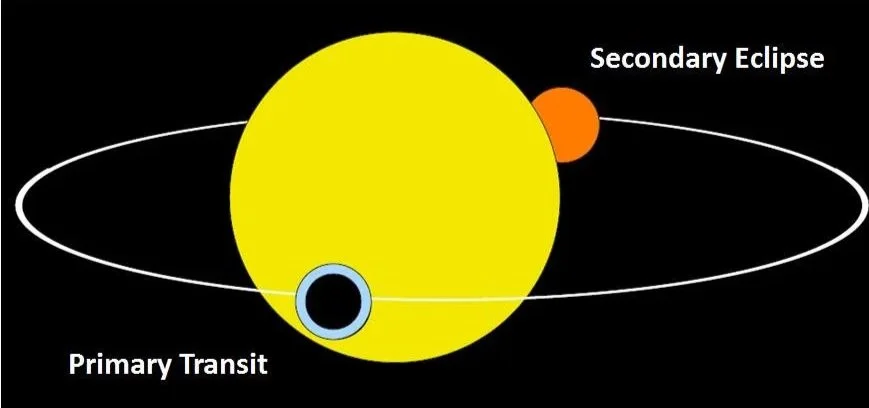
Image Credit: Sara Seager & Alexis Smith
We can also observe when the exoplanet passes behind its star. We call this an eclipse. With an eclipse, we can actually measure the light from the exoplanet itself!
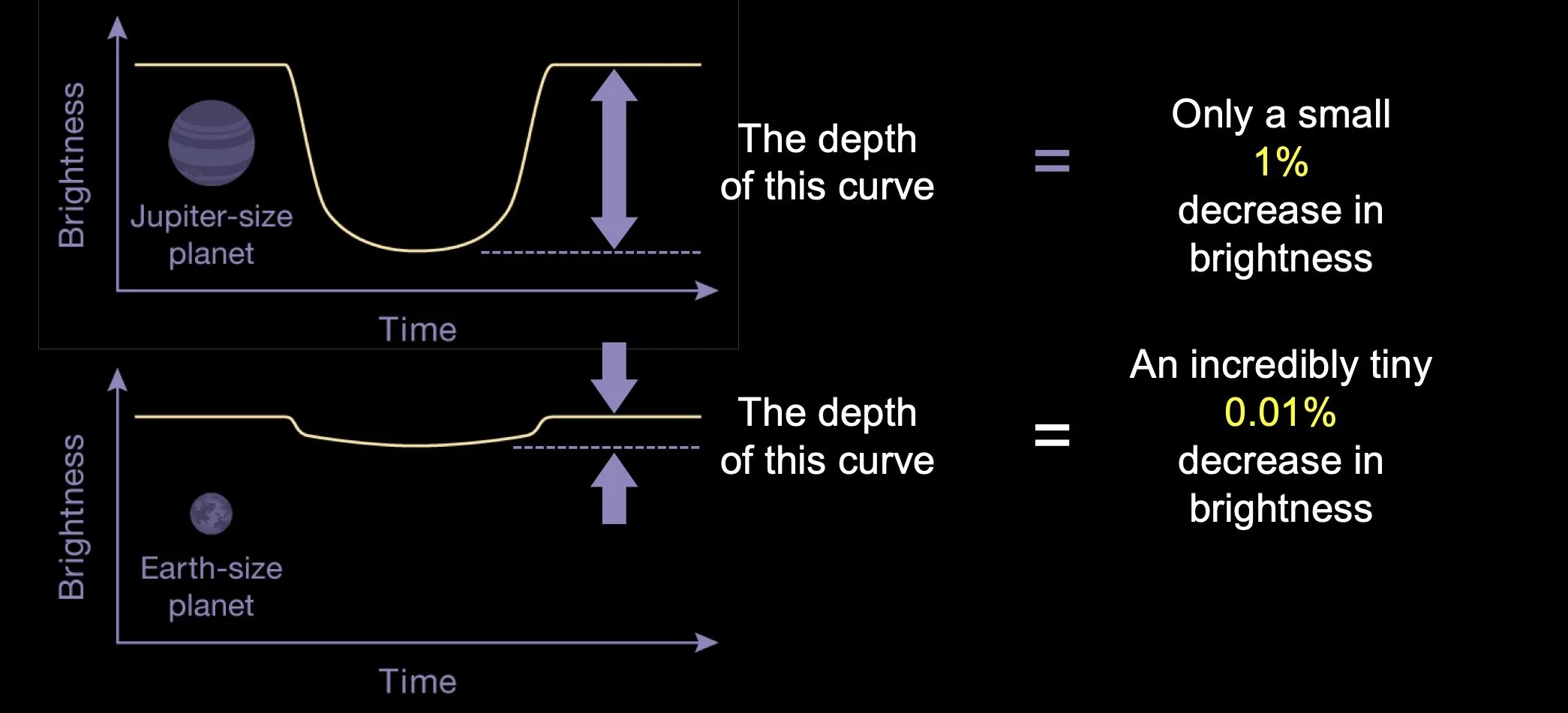
Comparison of a transit between a Jupiter-sized and Earth-sized planet. | Image Credit: NASA/JPL-Caltech
Exoplanet Atmospheres
Spectroscopy is one of the most important tools in astronomy. By separating light into its individual wavelengths, astronomers can infer the physical properties (e.g., temperature, density) and composition of a planetary atmosphere. Atoms and molecules imprint distinctive patterns onto light, effectively creating a fingerprint that reveals their nature even from great distances.
In exoplanet studies, astronomers use spectroscopy to probe atmospheric compositions, most notably through transmission spectroscopy. By observing a planet as it transits its star, we measure how strongly the atmosphere absorbs starlight at different wavelengths.
Since 2002, this technique has been widely used in the exoplanet community. With the launch of JWST, we have entered a new era of atmospheric studies, enabling detailed characterization of not only giant planets but also smaller worlds.
How do we study exoplanet atmospheres? | Ryan MacDonald
Sniffing Exoplanet Atmospheres with JWST: Prof. Nikole Lewis at Cornell University | Carl Sagan Institute
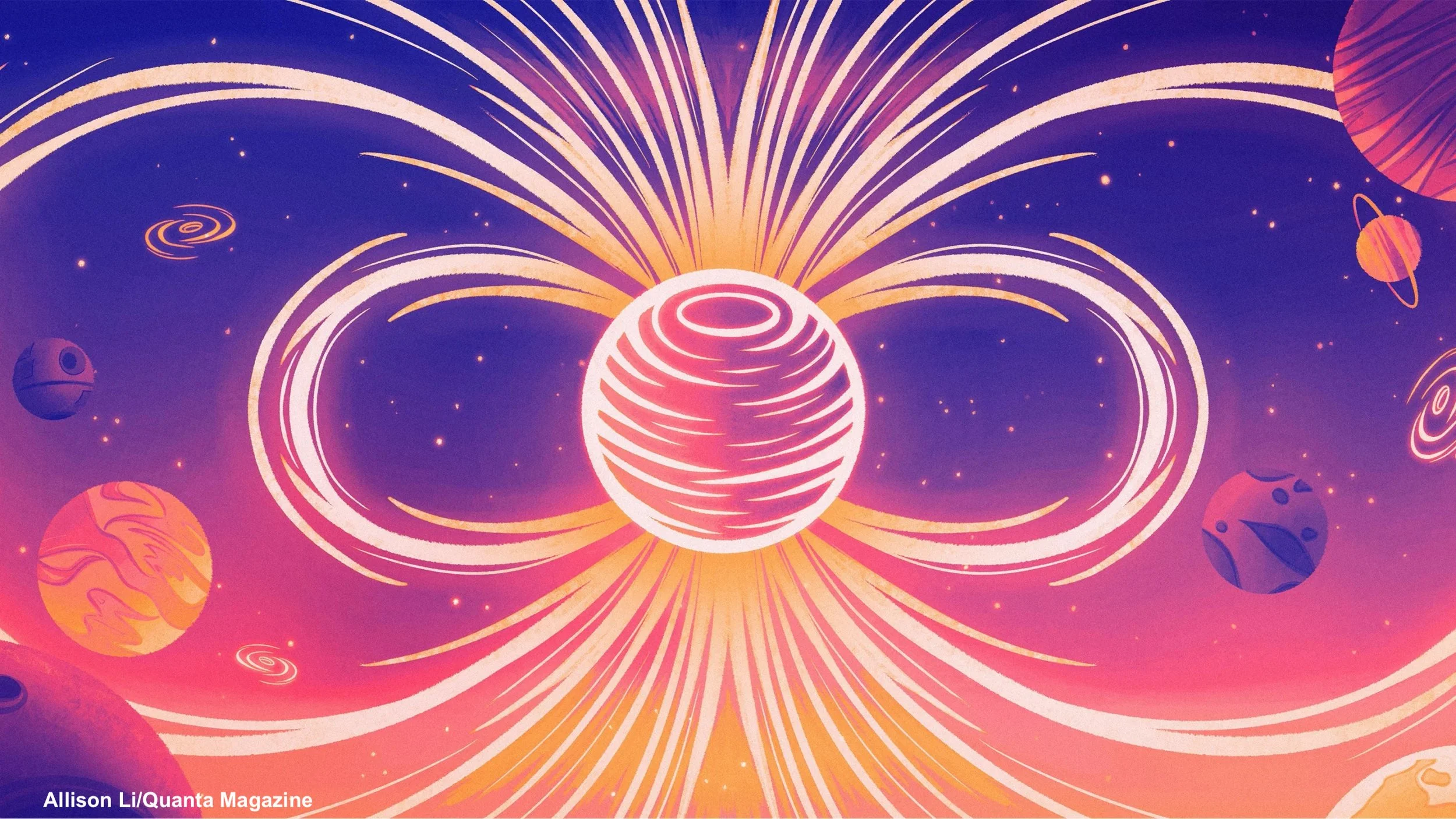
Exoplanet Magnetic Fields
In our Solar System, all the planets (except Venus?) and some moons (e.g., The Moon, Ganymede) currently have or had a magnetic field.
Planets with and without a magnetic field form, behave, and evolve very differently. This same phenomenon is expected to be true for exoplanets (but we need to find out!). Therefore, there is a great need to directly constrain these fields to understand the properties of exoplanets holistically. However, despite decades of searching, there is still no conclusive direct detection of an exoplanet's magnetic field. Although promising hints are starting to emerge through my research.
To start, knowledge of an exoplanetary magnetic field can provide robust constraints on the planet’s interior structure. Magnetic fields are also important for understanding an exoplanet's atmospheric escape (either enhancing or suppressing), atmospheric dynamics, formation and evolution, and even its habitability. On Earth, our magnetic field protects us from solar and cosmic particle radiation, as well as erosion of the atmosphere by the solar wind. A magnetic field can also inform us if the interior structure of a terrestrial planet is suitable for life or not. Therefore, studying planetary magnetic fields is essential for understanding and finding life in the universe.
Many different methods to detect exoplanet magnetic fields has been proposed. One of the most promising methods to detect exoplanetary magnetic fields is to study their auroral radio emission. I have also worked on several other techniques including star-planet interactions and bow shocks.
Auroral Radio Emission Observations
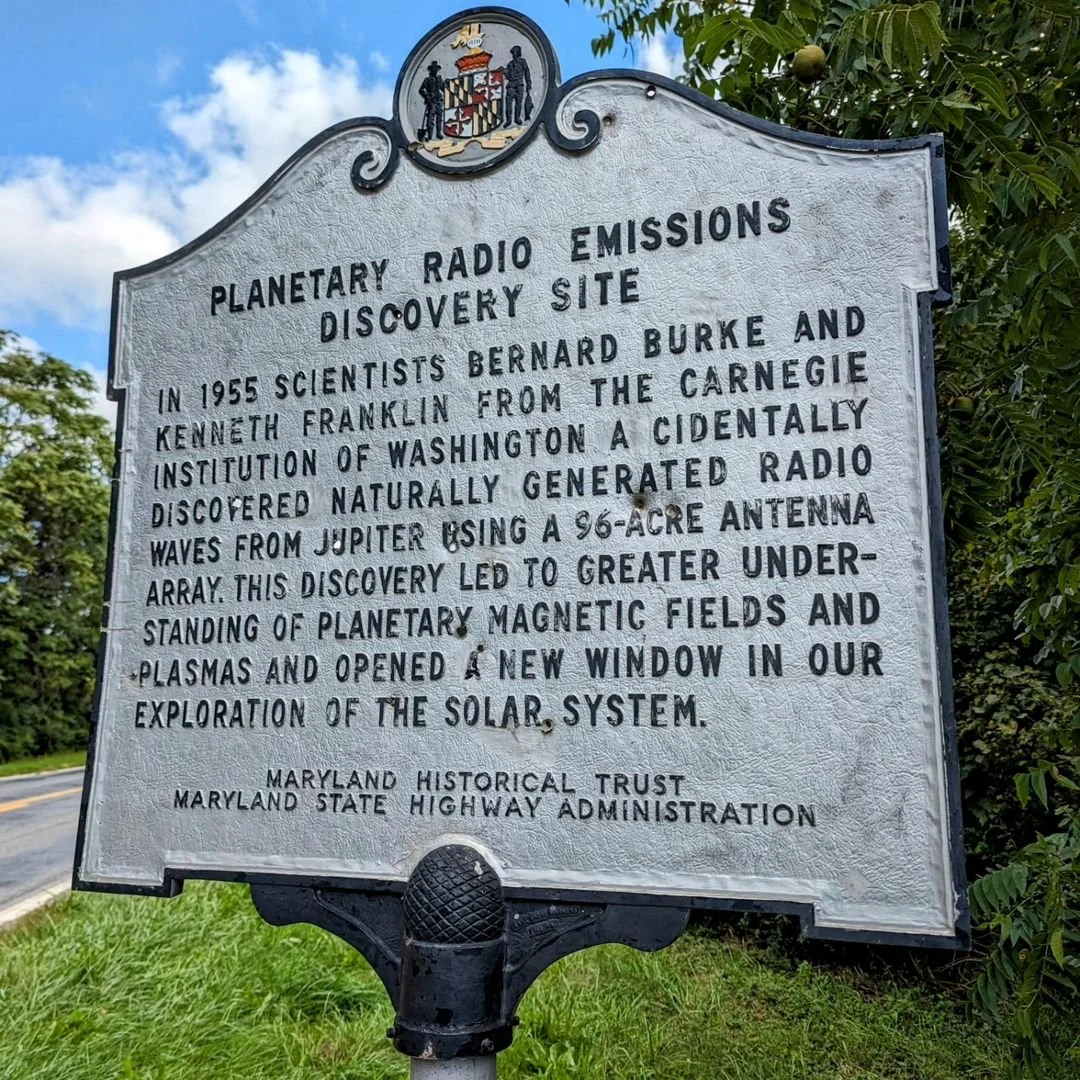
All the magnetized planets and moons in our Solar System naturally emit auroral radio emissions. In fact, the first proof of Jupiter’s magnetic field, the first measured magnetic field of a planet other than Earth, came from observing its radio emission. The radio frequencies (0.1 - 40 MHz) emitted by the Solar System planets can not be heard by the ear. We can only study them with power radio antennas from the ground (e.g., Mills Cross Array, LOFAR, NenuFAR) or spacecraft in space (e..g, Voyager, Cassini).

The Mills Cross Array discovered the radio emissions of Jupiter. It was located in Poolsville, Maryland, which is about 25 miles outside DC. | Image Credi: Archives of the Carngie Institution of Washington.
I took a pilgrimage to the discovery site of Jupiter’s radio emission after giving a talk at the Carnegie Earth & Planets Laboratory. We stand on the shoulders of giants!
Auroral radio emissions are caused by electrons from the stellar wind interacting with the planetary magnetosphere. As these electrons spiral along the magnetic field lines, they emit radio waves. The same electrons eventually interact with the planetary atmosphere. This interaction causes the beautiful optical aurora (e.g., Northern lights) we can see on Earth and other planets. This is why we call it auroral radio emission.
In this video, Dr. Jake Turner presets the first possible radio detection of an exoplanet in the radio. They also explain the mechanisms that produce planetary radio emission and the information radio studies can reveal about planets. | Cornell University

Northern lights over Cayuga Lake in Ithaca, NY. This picture was taken during a strong geomagnetic storm in October 2024. Image Credit: Jake Turner
The frequency of the radio waves are directly proposal to the planet’s field strength (like a radio dial):
Larger Planet —> Larger Magnetic Field —> Higher Frequency
In our Solar System, only Jupiter has a strong enough magnetic field to be studied from the ground. This will also be the case for exoplanets. Thus, we will need Lunar or space radio telescopes to study the magnetic fields of smaller planets (e.g., Saturn-sized to terrestrial-sized) including potentially habitable terrestrial planets.
For half-a-century, astronomers predicted that exoplanets could be studied in the radio and searches have been on-going.
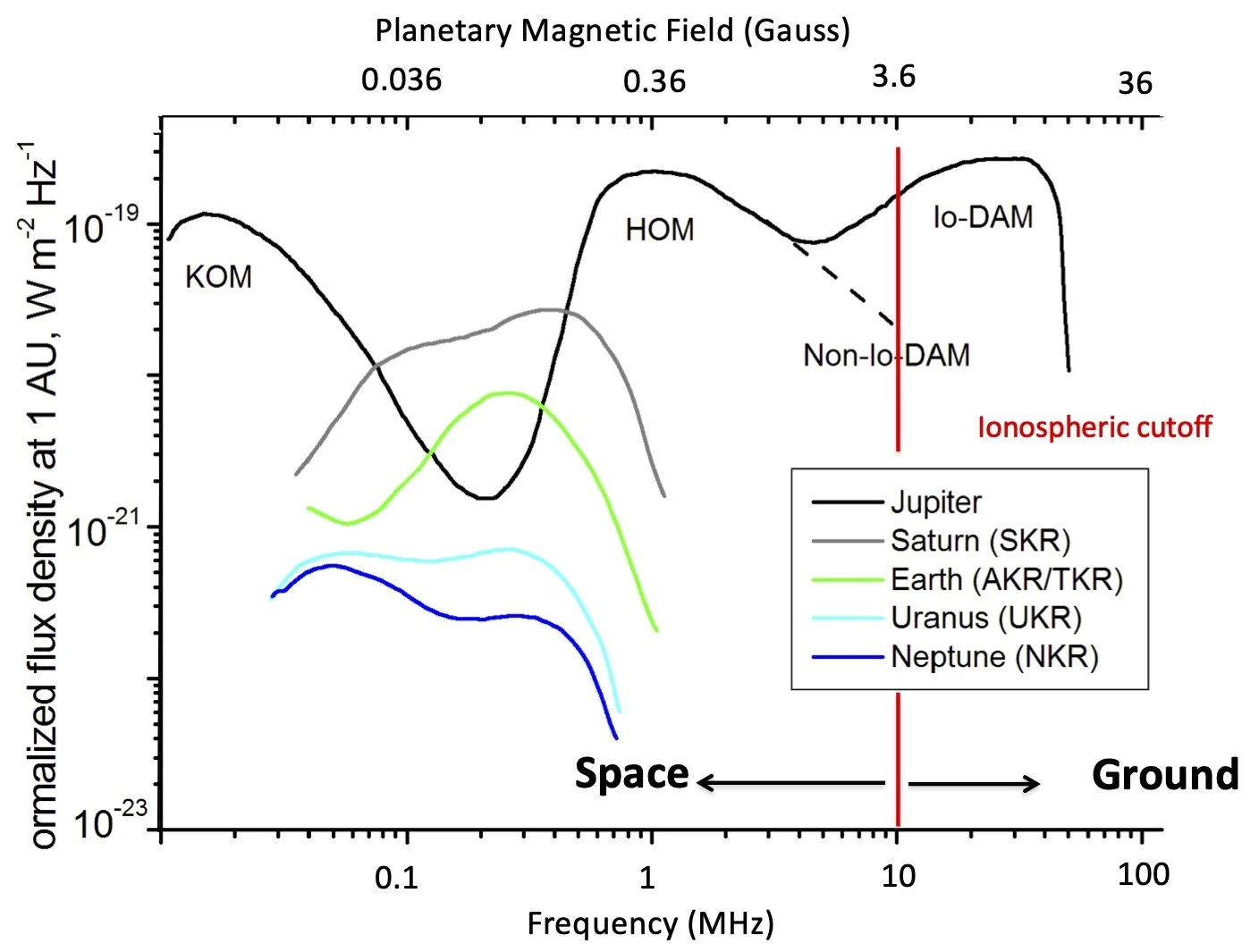
Comparative radio spectra for the Solar System planets. Only Jupiter can be detected from the ground. This Figure is from Turner et al. (2025).
Magnetic Bow Shocks
The Earth’s magnetosphere shields us from solar and cosmic particle radiation, as well as erosion of the atmosphere by the solar wind. The solar wind impinges on the magnetosphere at supersonic speeds, creating a bow shock. All the planets in the Solar System have bow shocks even if they don’t have magnetic fields. However, bow shocks have never been detected with remote sensing.
In 2010, it was predicted that the magnetic field of a transiting exoplanet could be constrained by observing near-UV light curve asymmetries. If the material in the bow shock is able to absorb starlight, then extra starlight is blocked at the start of the transit. See the video below.
Before my research, there was not a statistical ground-based sample searching for near-UV asymmetries or a physically motivated model to explain the phenomenon.
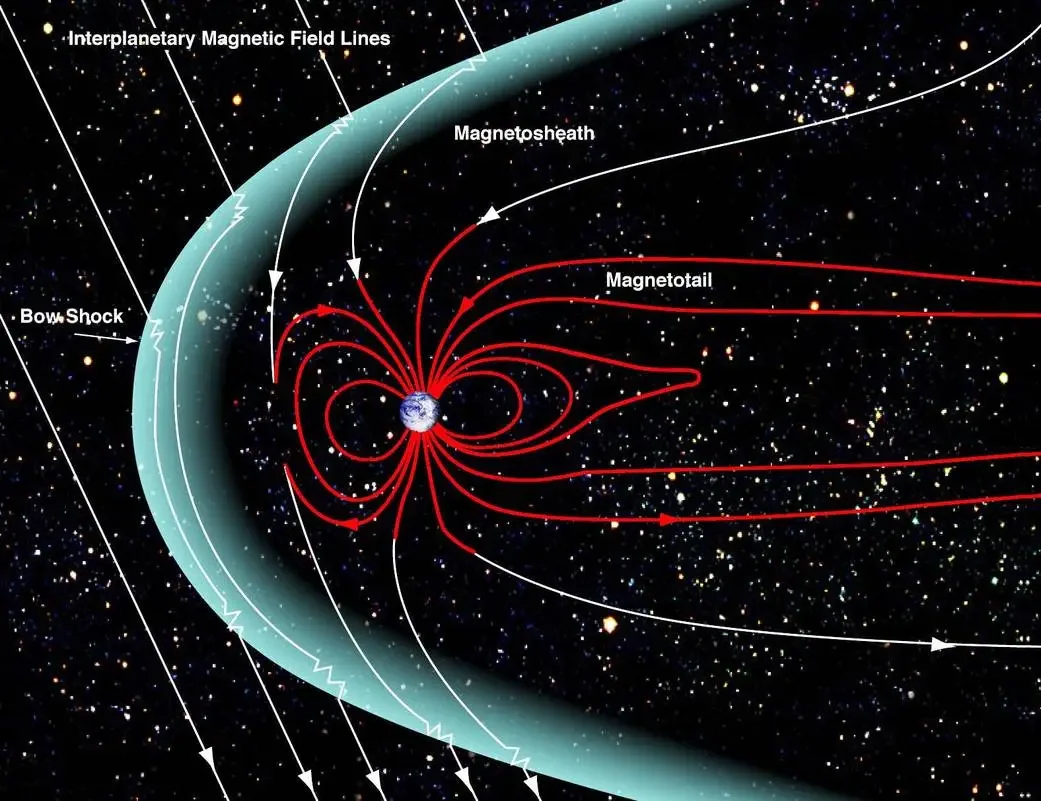
A magnetosphere is that area of space, around a planet, that is controlled by the planet's magnetic field. The shape of the Earth's magnetosphere is the direct result of being blasted by solar wind. | Image Credit: NASA
Simulation of a planet and a magnetospheric bow shock transiting a star. The bow shock causes extra absorbtion to occur. | Video Credit: Joe Llama
Magnetic Star-Planet Interactions
A close-in planet may induce magnetic star-planet interactions (SPI). If the planet orbits within the Alfven surface of the star, it can disrupt the star’s magnetic field, generating Alfven waves that travel back toward the star. This interaction can produce multi-wavelength observable effects that are modulated by the orbit of the planet.
All the Galilean moons induced multi-wavelength aurora on Jupiter. Thus, you don’t always need a magnetic field to produce SPI.
Two decades ago, the first indirect evidence of exoplanetary magnetic fields came from observational signatures of magnetic SPI in the form of planet-induced stellar activity such as that seen in the Ca II H & K lines. However, several new studies have claimed that the original optical SPI signatures are not statistically robust and need to be reevaluated.
Likewise, SPI in the form of planet-induced radio aurora on their host stars can be used to study exoplanetary magnetic fields. This has been done successfully to constrain the magnetic field of Ganymede through its induced radio aurora from Jupiter. Searches are ongoing to find SPI in exoplanets.
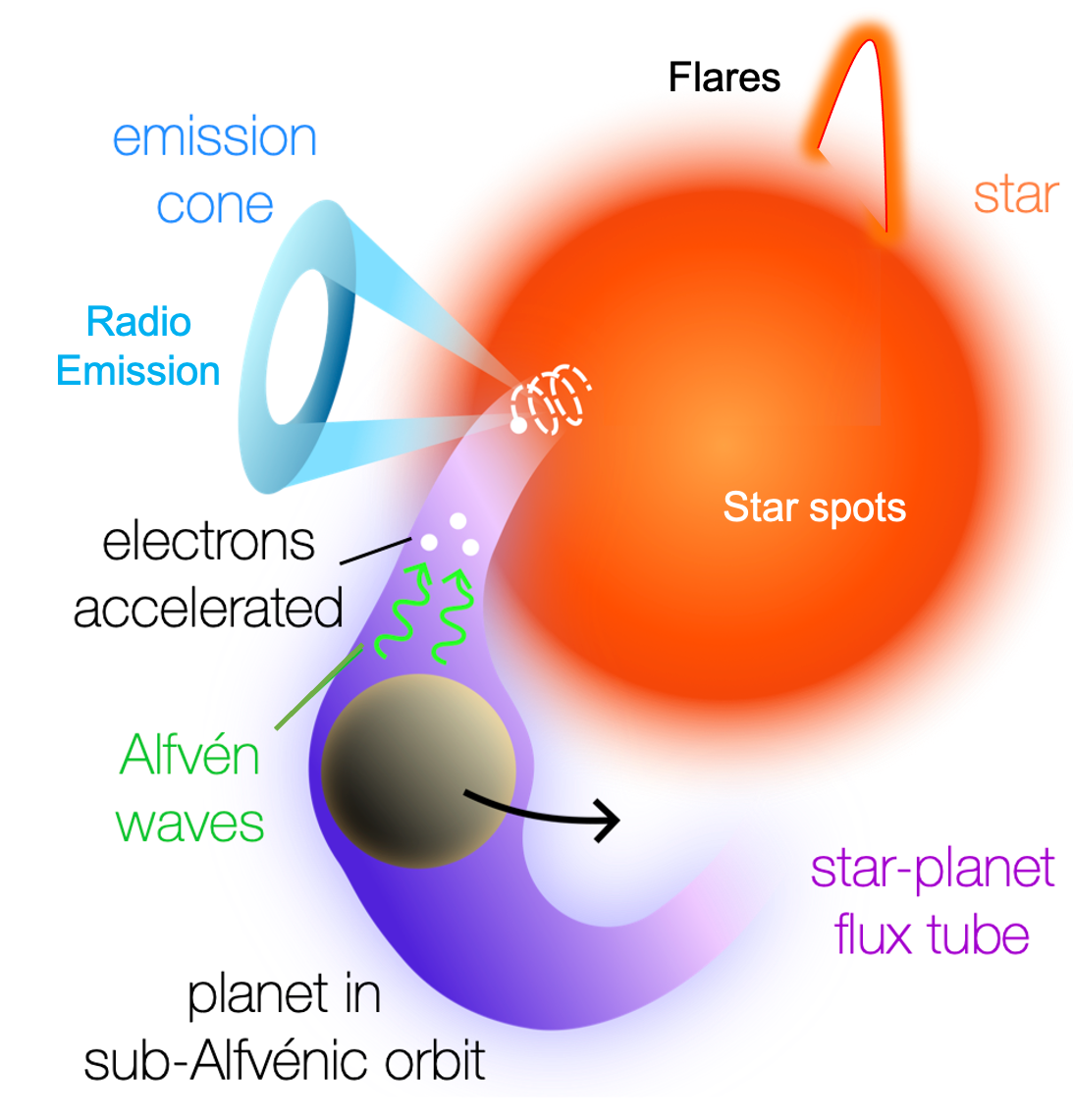
Sketch illustrating the observational consequences of magnetic star-planet interactions (SPI). SPI can modulate stellar activity, radio emission, and flares in phase with the planetary orbit. This figure is adopted from the Radio Stars and Exoplanets Lorentz Workshop.
Ganymede’s magnetic interaction with Jupiter. | Video Credit: NASA/Southwest Research Institute
SETI (Search for Extraterrestrial Intelligence)
The goal of SETI is to detect technosignatures (e.g., signs of technology) from extraterrestrial civilizations and help answer the question that humanity has been asking for thousands of years: ‘‘Are we alone?’’.
Beginning in the 1960s, the most active SETI field by far is the search for radio signals produced by extraterrestrial technology.
Today, SETI searches span the full electromagnetic spectrum and even encompasses multimessenger approaches. The SETI field is undergoing a renaissance marked by a dramatic expansion in both scale and scope.
Follow The SETI Institute to get the latest news about our research, talks, exclusive articles, and podcasts.
History and Status of SETI: The Search for Extraterrestrial Intelligence. | Dr. Nora's Guide to the Galaxy
“The discovery of intelligent life beyond Earth would eradicate the loneliness and solipsism that has plagued our species since its inception. And it wouldn’t simply change everything, it would change everything at once.” Dr. Jill Tarter, SETI Insitute